Window Condensation in Winter: Humidity or Bad Seal?
Foggy windows or frost indoors this winter? Learn the humidity table, the between-the-panes test, and when it's actually a failed window seal.
Why Do Windows Get Condensation or Frost in Winter?
Condensation forms when air carrying moisture touches a surface colder than its dew point and can no longer hold that moisture, so it drops out as liquid water, or as ice once the surface sits below freezing. Window glass is almost always the coldest surface in a heated room, which is why moisture shows up there first.
The physics comes down to three variables: how much moisture is in the air, how warm that air is, and how cold the glass gets. Turn up the humidifier, let the outdoor temperature drop, or both, and the dew point threshold moves closer to your actual room temperature.
Glass acts as an early warning system for a home's overall moisture balance, because it has the least insulating value of any surface in most rooms. A double-pane window's interior glass runs noticeably colder than the drywall a few feet away on a single-digit night, so it crosses the dew point first while the wall stays dry. If you're seeing frost or fog on the glass but nothing on the walls, that doesn't automatically mean your windows are failing, it means they're doing exactly what glass does.
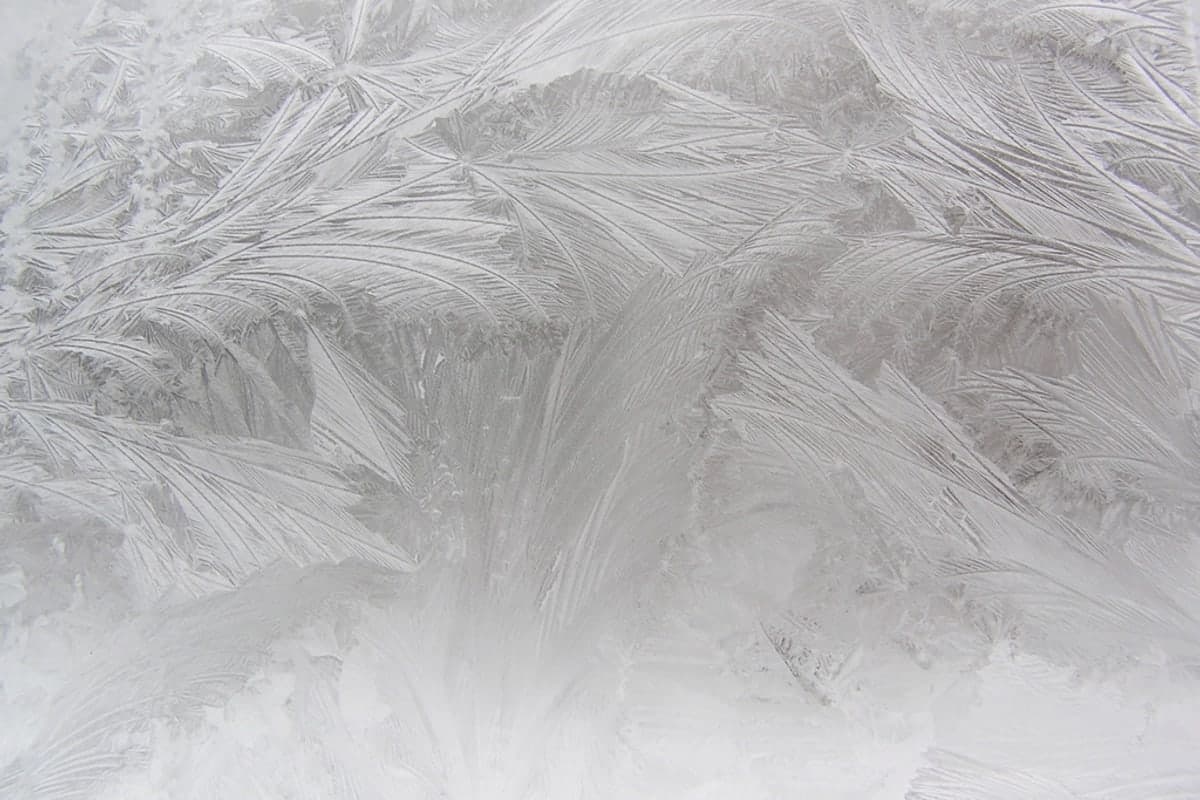
Frost and liquid condensation are the same event at two different temperatures. Above freezing, water vapor condenses into visible droplets. Below freezing, it deposits directly as ice crystals on the glass. Neither one, by itself, tells you anything about whether the window is healthy. The temperature threshold is doing all the work.
What Is the Recommended Indoor Humidity for My Outdoor Temperature?
There's no single "correct" indoor humidity number for winter. The safe ceiling drops as the outdoor temperature drops, because colder outdoor air pulls the interior glass surface temperature down with it, and colder glass hits its dew point at a lower relative humidity. Cardinal Glass Industries, a major manufacturer of insulated glass units, publishes a reference table pairing outdoor temperature with the maximum indoor relative humidity that should keep condensation off standard double-pane glass (Cardinal Glass Industries, 2024, retrieved 2026-08-02):
Two things to note about this table. First, the "20°F and above" band is published as a 35 to 40 percent range, not a single hard number, so the chart shows the upper bound for a clean visual, treat it as a ceiling to stay under rather than a target to hit. Second, broader public health guidance points the same direction without the temperature-based nuance: the EPA recommends keeping indoor humidity below 60 percent, ideally between 30 and 50 percent (U.S. EPA, 2026, retrieved 2026-08-02), and University of Minnesota Extension recommends a winter target around 25 percent, rising to about 50 percent in summer (University of Minnesota Extension, 2023, retrieved 2026-08-02). If your hygrometer reads within the Cardinal table's ceiling for tonight's forecast low, high indoor humidity probably isn't your problem, and the cause is likely sitting in the next section instead.
Is the Problem My Humidity, My Ventilation, or My Windows?
Most winter condensation calls turn out to be a humidity or ventilation issue rather than a window defect, and the fix is a lot cheaper when it's the former. Run this quick check before you blame the windows.
The 5-Minute Diagnostic: Where Is the Moisture Actually Sitting?
Step 1: Find the exact surface. Wipe the window dry and look again in a few hours. Is the moisture on the inside face of the glass you can touch, sandwiched between the two panes where you can't reach it, or on the outside face? Each answer points somewhere different, and the between-the-panes case gets its own section below, because it's the one case that's actually about the window itself.
Step 2: Check whether it's isolated or whole-house. Condensation on one north-facing bedroom window with the door kept shut usually points to a local ventilation gap in that room, not a house-wide humidity problem. Fog or frost across every window in the house, on different walls and in different rooms, points to overall indoor humidity running too high for the outdoor temperature.
Step 3: Cross-check your actual humidity. A $10 hygrometer shows your real indoor relative humidity in about a minute. Compare that reading to tonight's outdoor low and the table above. If your number sits above the ceiling for that temperature, that's your answer, and it's a humidity problem rather than a window problem.
If interior-face condensation clears once you bring indoor humidity down into the table's range, the window did its job as an early warning system, nothing more. If it doesn't clear, or if the moisture is sitting between the panes, keep reading.
What Does Condensation Between the Window Panes Actually Mean?
Condensation trapped between the two panes of a double- or triple-pane window is the one case in this article that actually is a window problem, not a humidity problem. Every insulated glass unit (IGU) is built as a sealed sandwich: two or three panes of glass, a spacer bar often packed with a moisture-absorbing desiccant, and a perimeter seal that keeps argon or another insulating gas locked inside while keeping outside air and moisture out. When that seal fails, whatever's happening inside your home stops being relevant.
Seal failure lets outside moisture work its way into the airspace a little at a time. The desiccant in the spacer absorbs it at first, buying time, but eventually the desiccant saturates and can't take on any more. From that point forward, any humid day produces fog or frost inside the sealed cavity, exactly where no amount of running a dehumidifier, cracking a window, or running the bathroom fan can reach it. This is the tell that separates a hardware problem from a humidity problem: interior-face condensation responds to ventilation and humidity control, while between-the-pane condensation doesn't respond to anything you do inside the house, because the moisture isn't in your house's air anymore.
The Efficient Windows Collaborative, a window-industry technical resource affiliated with the National Fenestration Rating Council (NFRC), confirms the mechanism directly: seal failure "leads to the loss of insulating gas and can result in condensation from moisture penetrating between the panes," and notes that a well-fabricated IG unit normally loses gas at under 1 percent a year while the seal is intact (Efficient Windows Collaborative/NFRC, retrieved 2026-08-02). Seal quality varies a lot by construction era and manufacturer. Cardinal Glass Industries' own warranty-claim data shows roughly 8.2 percent cumulative seal failure by 20 years for 1970s-era organically sealed units, versus about 0.2 percent by 20 years for modern dual-seal construction using a silicone secondary seal and a stainless-steel spacer (Cardinal Glass Industries (Cardinal IG), 2016, retrieved 2026-08-02). A failed seal isn't a structural emergency, the window still closes, locks, and keeps out weather, but it does mean that unit has lost its insulating value at that spot, and the fog or frost trapped inside will not clear on its own.
The good news is that between-the-pane condensation rarely means replacing the entire window. InterNACHI (International Association of Certified Home Inspectors) estimates that the glazing assembly alone, just the glass unit, not the frame or sash, can be swapped in about 75 percent of cases, with a full sash replacement needed occasionally and a complete window replacement required only around 5 percent of the time (InterNACHI, retrieved 2026-08-02). That page doesn't carry a visible publish date, so treat the underlying mechanism as solid and the exact percentages as a directional estimate rather than a rigorously sourced industry statistic. Either way, a glass-only swap is normally a fraction of the cost and disruption of a full window replacement. If the diagnostic above points you here, our window repair-vs-replace guide walks through how to weigh a glass-unit repair against full replacement for your specific window's age and condition, and before you hire anyone for the repair, it's worth confirming the contractor is properly licensed and insured and bringing a short list of vetting questions to the first estimate.
Is Condensation on the Outside of My Windows a Problem?
No, and it's frequently a sign your windows are doing their job well. Exterior condensation happens through the same dew-point physics as dew forming on grass or on a parked car: on a clear night, the outside glass surface radiates heat to the sky and cools below the surrounding air's dew point, so moisture condenses on it before the sun burns it off in the morning.
The Fenestration Association of BC (FENBC), a Canadian glazing trade association, explains it plainly: condensation forming on the outside of a window means very little heat from inside the house is escaping through the glass, which is "proof that you have energy-efficient windows" (Fenestration Association of BC, retrieved 2026-08-02). That explanation is about the physics of glass and clear night skies, which doesn't change at the border, but FENBC is a regional Canadian trade body, not a US or Midwest-specific standards organization, so treat it as one credible technical source rather than a US regulatory position. Exterior condensation shows up most in the shoulder seasons, late summer and early fall nights when the temperature drop between day and night is largest, and it clears on its own once the sun warms the glass. Nothing about it calls for a fix.
Where Is All This Moisture Coming From in a Tight, Energy-Efficient Home?
If your diagnostic points to a whole-house humidity problem, that moisture has to be coming from somewhere, and in most homes it's coming from ordinary daily life. University of Missouri Extension breaks down where an average family of four's household moisture actually originates: an unvented clothes dryer contributes about 26.4 pounds of moisture a day, breathing and perspiring add roughly 16.8 pounds, washing clothes adds 4.3 pounds, mopping floors adds 2.4 pounds, unvented cooking on an electric range adds about 2 pounds, showering or bathing adds 2 pounds, hand-washing dishes adds 1 pound, and houseplants add another pound. Altogether that's close to 56 pounds, or roughly 6.7 gallons, of water vapor released into the air every single day (University of Missouri Extension, 2014, retrieved 2026-08-02).
Older, leakier homes vented a lot of that moisture outside by accident, through gaps around doors, outlets, and framing that a modern energy-efficient home no longer has. The EPA's weatherization guidance makes the tradeoff explicit: sealing up a home to save on heating bills is good for energy costs, but "weatherizing without maintaining proper ventilation can negatively affect indoor air," and the agency points to ASHRAE's Residential Ventilation Standard 62.2 as the benchmark for how much fresh-air exchange a sealed home still needs (U.S. EPA, 2026, retrieved 2026-08-02). In practice, a well-insulated, well-sealed home can trap more of that daily 6.7 gallons than a drafty older house ever could, which is exactly why condensation complaints often start right after an insulation upgrade or a new siding job, not after the windows go in.
What's the Cheapest Way to Fix Window Condensation?
Once you've confirmed the problem is humidity or ventilation rather than a failed seal, work through fixes cheapest and least disruptive first. Run bathroom and kitchen exhaust fans an extra 15 to 20 minutes after a shower or a meal, longer than most people leave them running, and vent the clothes dryer outside if it isn't already, since an unvented dryer is one of the largest moisture sources in the Missouri Extension breakdown above.
Crack a window periodically in the coldest rooms, or run an energy recovery ventilator (ERV) or heat recovery ventilator (HRV) if your home has one, since a tightly sealed house depends on mechanical ventilation to do what drafts used to do for free. Run a portable dehumidifier in whichever room the diagnostic flagged, and if you run a whole-house humidifier, lower its setpoint for the coldest stretches of winter instead of a fixed year-round number. Keep air moving near cold windows with a small fan or by opening blinds during the day, since still air against cold glass condenses faster than air that's circulating. Adding or upgrading storm windows adds a second air gap that keeps the interior pane warmer without touching the primary window at all.
Only after working through that list, if the diagnostic pointed to a failed seal or to genuinely single-pane glass rather than a humidity issue, does full window replacement belong in the conversation. If you're at that point and want to understand what a meaningful upgrade actually buys you in insulating performance, see our comparison of double-pane and triple-pane glass. If you're weighing whether replacement pencils out financially, our payback-period breakdown covers that math, and if you're in Wisconsin and want a sense of what replacement costs locally, see our regional cost guide.
What Happens If Window Condensation Is Ignored?
Left alone, chronic window condensation creates the exact conditions mold needs: repeatedly wetted surfaces that never fully dry. The EPA notes that if wet or damp materials are dried within 24 to 48 hours of getting wet, mold generally will not grow, but condensation that reappears every cold morning never gets that 24-to-48-hour window to dry out, it just keeps rewetting the same surfaces (U.S. EPA, 2026, retrieved 2026-08-02).
Sills and frames are usually the first casualties: wood sills swell, paint fails and peels, and prolonged wetting leads to rot at the corners where water pools longest. Moisture running down the frame into the wall cavity below can wet drywall and insulation that never fully dries between cold snaps, exactly the kind of hidden, sustained dampness that supports mold growth, unlike the single wetting event the EPA's 24-to-48-hour guidance describes. That mold growth carries a genuine health angle, since the same EPA guidance links unmanaged indoor moisture to a higher risk of mold-related allergy and respiratory symptoms, which is the real reason to treat recurring condensation as a maintenance item rather than a cosmetic one, even when it turns out to be a humidity problem rather than a window problem.
Frequently Asked Questions
- What indoor humidity level stops window condensation in winter?
- It depends on how cold it is outside. Cardinal Glass Industries' reference table pairs outdoor temperature with a maximum safe indoor humidity: about 35 to 40 percent at 20°F and above, dropping to 30 percent at 10°F, 25 percent at 0°F, 20 percent at -10°F, and 15 percent at -20°F (Cardinal Glass Industries, 2024). As a general baseline that doesn't factor in outdoor temperature, the EPA recommends staying below 60 percent and ideally between 30 and 50 percent (U.S. EPA, 2026), and University of Minnesota Extension recommends a winter target around 25 percent, rising to about 50 percent in summer (University of Minnesota Extension, 2023).
- Does condensation between the glass panes mean I need new windows?
- Not necessarily a full window. Condensation trapped between the panes means the insulated glass unit's seal has failed, letting outside moisture in where no amount of dehumidifying or ventilating can reach it (Efficient Windows Collaborative/NFRC, retrieved 2026-08-02). InterNACHI estimates the glass unit alone can be replaced in about 75 percent of these cases, with full window replacement needed only around 5 percent of the time, though that page carries no visible publish date, so treat the exact percentages as directional rather than a firm industry statistic (InterNACHI, retrieved 2026-08-02). See our window repair-vs-replace guide for how to weigh the options for your specific window.
- Is condensation on the outside of my windows something to worry about?
- No. Exterior condensation forms through the same dew-point physics as dew on grass or a parked car, and it's frequently a sign of energy-efficient glass keeping heat inside rather than a defect. The Fenestration Association of BC notes that condensation forming on the outside of a window means very little indoor heat is escaping through the glass (Fenestration Association of BC, retrieved 2026-08-02). It typically appears on clear nights in late summer and early fall and clears on its own once the sun warms the glass.
- How much moisture does a household actually produce in winter?
- A lot more than most people expect. University of Missouri Extension estimates an average family of four generates roughly 56 pounds, or about 6.7 gallons, of water vapor a day from ordinary activities: an unvented clothes dryer alone contributes about 26.4 pounds, breathing and perspiring add 16.8 pounds, and cooking, bathing, dishwashing, and houseplants make up most of the rest (University of Missouri Extension, 2014).
- How fast can mold start growing from window condensation?
- The EPA notes that wet or damp materials generally will not develop mold if they are dried within 24 to 48 hours of getting wet (U.S. EPA, 2026). Chronic window condensation that reappears every cold morning never gets that drying window, because the sill, frame, or nearby wall cavity gets rewetted before it fully dries out, which is why recurring condensation is worth fixing rather than just wiping up each morning.
- Do newer, tightly sealed, energy-efficient homes get worse condensation?
- Often, yes. The EPA points out that weatherizing a home without maintaining proper ventilation can negatively affect indoor air quality, and references ASHRAE's Residential Ventilation Standard 62.2 as the benchmark for how much fresh air a sealed home still needs (U.S. EPA, 2026). Older, leakier homes vented daily household moisture outside by accident; a tightly sealed modern home traps that same moisture unless mechanical ventilation, such as exhaust fans or an ERV/HRV, does the job drafts used to do for free.