Garage Door Spring Replacement Cost & Types (2026 Guide)
Torsion vs extension garage door springs: how to tell them apart, 2026 replacement costs, cycle-rated lifespan, and why DIY spring repair is dangerous.
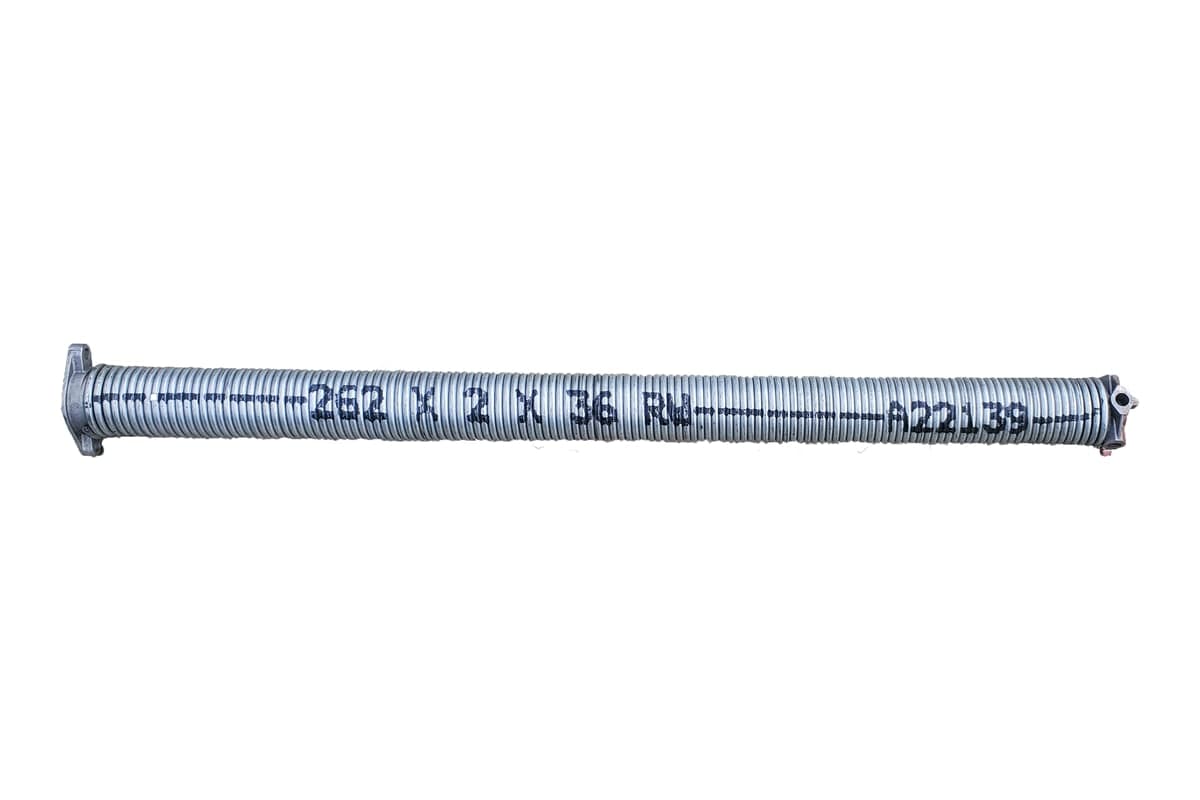
Torsion or Extension: Which Garage Door Spring Do You Have?
Look above the closed door first. One or two thick coiled springs mounted on a metal bar directly over the door opening are torsion springs. If instead you see long, thinner springs running along the upper track on either side of the door, stretching and contracting as it moves, those are extension springs.
The visual tell is the ends: torsion springs taper into cone-shaped fittings on a horizontal shaft, while extension springs end in open hooks or loops and, if installed correctly, have a thin safety cable threaded straight through the coil. Knowing which type you have before you call a contractor matters because pricing, parts, and repair urgency all differ by spring type. This article stays focused on the spring itself. If you're weighing whether the whole door needs to go rather than just the spring, our full repair-vs-replace decision guide covers that call in detail.
What's the Real Difference Between Torsion and Extension Springs?
Torsion springs mount horizontally above the door and store energy by twisting around a steel shaft; a cable-and-drum system converts that twisting force into the lift that raises the door. Extension springs mount along the horizontal tracks and store energy by stretching, releasing tension as the door closes and pulling it back open. Torsion springs generally last longer and handle heavier doors more smoothly, which is why most modern two-car garage doors use a torsion setup, while extension springs remain common on older or lighter single-car doors.
Cost tracks that durability difference. Installed as a full set, torsion springs run $350 to $540 while extension springs run $300 to $400, a gap of roughly $50 to $140 (This Old House, Garage Door Spring Replacement Cost, 2026). Priced individually, a single torsion spring for a standard 150-pound door with a 10,000-cycle rating and a one-year warranty runs $319 to $562, covering the spring itself, labor, job supplies, and debris disposal (Homewyse, Cost to Update Garage Door Spring, 2026).
Safety is where the two types diverge most. This Old House flags torsion springs as "generally more dangerous to replace than extension springs" because winding one under tension requires specialized bars and precise technique (This Old House, Garage Door Spring Replacement Cost, 2026). Extension springs carry a different risk: without a properly anchored safety cable running through the coil, a broken extension spring can become a projectile, which is why DASMA specifies that a safety cable is required on every extension spring installation (DASMA, Garage Doors: Safety Tips, 2026).
How Long Do Garage Door Springs Actually Last?
In real-world terms, extension springs typically last 7 to 12 years and torsion springs 8 to 15 years, with both types commonly rated between 10,000 and 20,000 cycles (This Old House, Garage Door Spring Replacement Cost, 2026). A cycle is one full open-and-close of the door. Open the garage twice a day and you'll burn through cycles far slower than a household running a business out of it, or one opening the door for multiple vehicles.
One industry source converts cycle ratings into a rough years estimate assuming about 3 cycles a day of typical household use: a 10,000-cycle spring lasts roughly 9 years, a 20,000-cycle spring roughly 18.3 years, and a 30,000-cycle high-cycle spring roughly 27.4 years (GarageDoorGuide.com, High-Cycle Torsion Springs, retrieved 2026-08-01). Treat those numbers as an estimate range, not a guarantee. That source doesn't disclose where its 3-cycles-a-day assumption comes from, so treat the conversion as directional: higher cycle rating means longer service life, but the exact number of years depends heavily on how many times a day your specific household opens and closes the door, plus the climate factors covered below.
Cycle rating alone isn't a fixed guarantee either. DASMA's technical guidance treats spring cycle life as a function of handling, installation quality, and usage conditions, not a number stamped on the spring and left unaffected by anything else (DASMA Technical Data Sheet #190, Factors Affecting Spring Cycle Life, 2021).
What Does a Failing or Broken Spring Look Like?
A few signs point to a spring nearing the end of its life before it fails outright. On a torsion spring, look for a visible gap opening up in the coil, a sign the metal has stretched past its working tolerance. On an extension spring, watch for visible stretching, rust, or a coil that no longer snaps back cleanly when the door closes. A door that suddenly feels noticeably heavier to lift by hand, that won't stay open on its own partway up, or that produces a loud bang (usually the sound of the spring actually snapping) all point to spring failure.
If a spring has already broken, don't keep operating the door on the opener. DASMA's guidance is direct: if a door has two springs, "replace both, even if one is not broken" (DASMA, Garage Doors: Safety Tips, 2026), because running the door on a single remaining spring puts extra strain on both that spring and the opener. And on extension spring systems specifically, DASMA requires a safety cable running through the spring and anchored at both ends, precisely because "if the spring breaks, it may cause injury. A safety cable can keep that broken spring contained" (DASMA, Garage Doors: Safety Tips, 2026). If your extension springs don't have a visible cable, that's worth flagging to a technician on its own, independent of whether the spring has actually failed yet.
How Much Does Garage Door Spring Replacement Cost in 2026?
A single torsion spring on a standard 150-pound door runs $319 to $562 installed, per Homewyse's 2026 estimate built around a 10,000-cycle spring carrying a one-year warranty; that figure bundles the spring itself with labor, job supplies, and debris haul-away (Homewyse, Cost to Update Garage Door Spring, 2026). Because most two-spring torsion setups get replaced in pairs rather than one at a time, the realistic quote for a full set lands at $350 to $540 installed. Extension springs come in lower as a pair, at $300 to $400 installed (This Old House, Garage Door Spring Replacement Cost, 2026).
What pushes a quote toward the top of these ranges: a heavier or oversized door that needs a higher-rated spring, a higher cycle rating (a 20,000-cycle spring costs more upfront than a 10,000-cycle spring, though it lasts roughly twice as long), and same-day or emergency service, since a broken spring often means the door is stuck and the homeowner needs it fixed that day rather than scheduled out. This is a component-level repair, not a decision about the whole door. For the full economics of when a repair estimate (spring or otherwise) tips toward replacing the entire door instead, see our repair-vs-replace decision guide and its breakdown of the 50% rule.
Should You Replace One Spring or Both at the Same Time?
If your door has two springs and one has broken, the industry-standard advice is to replace both, not just the failed one. DASMA states this plainly: replace both springs "even if one is not broken" (DASMA, Garage Doors: Safety Tips, 2026). This Old House frames the same guidance in terms of wear: springs "usually work in pairs, and when one fails, its partner isn't far behind" (This Old House, Garage Door Spring Replacement Cost, 2026).
The mechanism behind the advice is straightforward. Both springs are installed at the same time and absorb roughly the same number of open-close cycles over their life, so if one has reached the end of its cycle rating, the other is statistically close behind it, even if it hasn't visibly failed yet. Running a two-spring door on one working spring also unbalances the lift: the opener and the surviving spring both take on more load than they're rated for, which can accelerate wear on the opener's motor and gears in addition to the spring itself. Replacing both at once costs more upfront than replacing a single spring, but it avoids a second service call, and a second spring failure, within a year or two of the first.
Why Is DIY Spring Replacement Dangerous?
This is one repair where the DIY-versus-professional line is unusually firm across every source consulted for this guide. DASMA's guidance states plainly that garage door springs "should be repaired only by trained professionals" (DASMA, Garage Doors: Safety Tips, 2026). This Old House goes a step further and distinguishes between the two spring types, noting that torsion springs are "generally more dangerous to replace than extension springs" because winding a torsion spring to the correct tension requires specialized winding bars and precise technique, and a spring under partial tension can release with enough force to cause serious injury (This Old House, Garage Door Spring Replacement Cost, 2026).
Extension springs carry a different but equally serious risk. A properly installed extension spring system includes a safety cable running through the coil and anchored at both ends, specifically because a spring under that much stored tension can turn into a projectile if it snaps without one (DASMA, Garage Doors: Safety Tips, 2026). A homeowner replacing an extension spring without understanding that cable's role, or skipping it to save time, is removing the one safeguard designed for exactly this failure mode.
The DIY-danger theme extends past springs to the rest of the door too. Our repair-vs-replace guide covers the regulatory history behind today's safety standards, including the federal auto-reverse mandate that followed a wave of garage door deaths in the early 1990s, if you want the fuller safety picture beyond springs specifically. For springs, the short version is: this is a same-day call to a technician, not a Saturday project. If you need help finding one, our guide to verifying a garage door contractor covers what to check before anyone touches a spring under tension in your garage.
How Does a Midwest Winter Affect Garage Door Spring Life?
DASMA's technical data sheet on spring cycle life names extreme heat or cold, frequent precipitation, and proximity to a saline coastal location as door-usage conditions that can reduce how long a spring lasts. It separately flags corrosive chemical exposure as its own risk factor. Rust on a spring doesn't just look bad, it reduces the effective strength of the wire and creates small corrosion pits that can accelerate fatigue cracking (DASMA Technical Data Sheet #190, Factors Affecting Spring Cycle Life, 2021).
Read that list against a Midwest driveway in January and the overlap is hard to miss. Road salt spray kicked up onto a garage door and its hardware, combined with repeated freeze-thaw cycling and the kind of temperature swings the Midwest sees between a January cold snap and a 40-degree thaw, line up closely with the extreme-temperature and corrosive-exposure conditions DASMA flags as spring cycle-life reducers, even though DASMA's own language is written around coastal salt air rather than winter de-icing salt specifically. No verified Midwest-specific cycle count exists to attach a hard number to that effect, so treat this as a mechanism, not a statistic: winters here supply conditions that share DASMA's named risk factors, which is one more reason a spring showing early wear signs in a Midwest garage is worth taking seriously rather than assuming it has years left just because it hasn't hit its rated cycle count. For how that plays into a broader seasonal inspection routine, our repair-vs-replace guide covers the case for spring and fall professional checkups in more detail.
When Should You Call a Professional, and When Does It Mean More Than Just the Spring?
Get a same-day quote once you've confirmed the spring itself has failed or is visibly close to it. But if the technician who comes out for the spring also flags opener strain, worn track rollers, or panel damage while they're already in the garage, that's the moment to widen the conversation beyond just the spring. A single spring replacement is a contained, predictable repair. Multiple issues surfacing at once is exactly the scenario where it's worth running the numbers on the whole door.
For that broader decision, our full repair-vs-replace decision guide walks through the 50% rule and how Midwest replacement economics compare to repair costs, and our garage door lifespan and replacement signs guide covers the age-based wear signals that matter regardless of what brought a technician out in the first place. If you end up needing a new door rather than a spring, our full replacement cost and ROI breakdown covers what that investment actually returns.
Whether you're calling about a spring or a whole new door, who does the work matters as much as what gets fixed. See how to verify a garage door contractor and questions to ask before hiring a garage door contractor before you book anyone to work on a component that's under this much stored tension.
Frequently Asked Questions
- How can I tell if my garage door has torsion springs or extension springs?
- Look above the closed door first. One or two thick coiled springs mounted on a metal bar directly over the door opening are torsion springs, identifiable by their cone-shaped ends. If instead you see long, thinner springs running along the upper track on either side of the door, stretching and contracting as it moves, those are extension springs, and a properly installed pair should each have a safety cable threaded through the coil (DASMA, Garage Doors: Safety Tips, 2026).
- How many years do garage door springs actually last?
- Extension springs typically last 7 to 12 years and torsion springs 8 to 15 years, with both types commonly rated between 10,000 and 20,000 cycles of use (This Old House, Garage Door Spring Replacement Cost, 2026). One open-close of the door counts as one cycle, so actual calendar years depend heavily on how often the door is used.
- If one garage door spring breaks, do I need to replace both?
- Yes, that's the standard industry recommendation. DASMA advises replacing both springs even if only one is broken, since they wear on a matched cycle and the surviving spring is typically close to failure itself (DASMA, Garage Doors: Safety Tips, 2026). This Old House notes the same logic: when one spring fails, "its partner isn't far behind" (This Old House, Garage Door Spring Replacement Cost, 2026).
- Is a torsion spring or an extension spring more expensive to replace?
- Torsion springs generally cost more. An installed pair runs $350 to $540 for torsion versus $300 to $400 for extension springs (This Old House, Garage Door Spring Replacement Cost, 2026). A single torsion spring, priced on its own, runs $319 to $562 for a standard 150-pound door with a 10,000-cycle spring (Homewyse, Cost to Update Garage Door Spring, 2026).
- Can I replace a garage door spring myself to save money?
- It isn't recommended. DASMA guidance states spring systems "should be repaired only by trained professionals" (DASMA, Garage Doors: Safety Tips, 2026), and This Old House specifically flags torsion springs as more dangerous to DIY than extension springs because winding one requires specialized bars and the spring is under extreme tension throughout the process (This Old House, Garage Door Spring Replacement Cost, 2026). An extension spring without its safety cable can also become a projectile if it breaks under tension.
- Does cold weather and road salt make garage door springs fail faster in the Midwest?
- The mechanism lines up with Midwest winters, though no region-specific failure number has been verified. DASMA identifies extreme heat and cold, frequent precipitation, and proximity to a saline coastal location as conditions that can reduce spring cycle life, and separately flags corrosive chemical exposure as a risk (DASMA Technical Data Sheet #190, Factors Affecting Spring Cycle Life, 2021). Road salt spray and freeze-thaw cycling line up closely with those same risk factors, even though DASMA's own wording is built around coastal salt air rather than winter de-icing salt specifically.